CGPA Calculator
This free CGPA calculator helps university students in Pakistan instantly calculate their Semester GPA and Cumulative CGPA using the standard HEC grading system. Whether you are a fresh student or preparing for graduation, just enter your credit hours and grades below to get accurate results in seconds.
1. Calculate Semester GPA
| Course Name (Optional) | Grade | Credit Hours | Action |
|---|
2. Calculate Cumulative CGPA
Enter your previous CGPA and total credit hours earned before this semester.

The Complete Guide to Understanding GPA and CGPA in Pakistan
Let's be completely honest with each other. When you step into a university in Pakistan, the terms "GPA" and "CGPA" are thrown around constantly. Parents ask about it over dinner, professors warn you about it in the first lecture, and scholarship committees use it as their primary filter. But what do they actually mean, and why does everyone care so much?
The problem is that most universities explain this system using confusing academic jargon. You hear words like "grade points," "credit hours," and "cumulative averages," and your brain just shuts down. That is exactly why we built this tool. We wanted to create a simple, reliable way for you to track your academic progress without needing a degree in mathematics. But a tool is only useful if you understand the numbers it's giving you. So, let's break down the entire grading system in a way that actually makes sense.
What Exactly is the Difference Between GPA and CGPA?
Think of your academic journey as a long cricket tournament.
- GPA (Grade Point Average): This is your performance in a single match (or semester). It tells you how well you did in the last 4 to 5 months. It is calculated based on the grades you received in your specific courses and their credit hours. Once the semester ends, this number is locked in. But here's the catch: it resets in the next semester.
- CGPA (Cumulative Grade Point Average): This is your performance in the entire tournament. It is the average of all the semester GPAs you have earned since you started your degree. It is the big picture number that appears on your final transcript and is used by employers to judge your overall academic consistency.
Here is the most important thing every student needs to understand: Because CGPA is an average, one bad semester won't destroy your entire degree. If you have been a consistent student for three years, a single C grade won't tank your CGPA. However, the reverse is also true. If you slack off in your first two years, it becomes incredibly difficult to pull your CGPA up in the final years, no matter how hard you study. The math just doesn't allow it.
Demystifying the HEC Pakistan Grading System
The Higher Education Commission (HEC) of Pakistan provides a standard framework for grading, but here is where it gets slightly tricky: not every university follows the exact same scale. Some universities use a 4.0 scale, some use a 4.5 scale, and some even use percentages.
However, the vast majority of institutions (including NUST, FAST, UET, and Punjab University) use a variation of the standard 4.0 scale. Our calculator is built on this widely accepted HEC-aligned system.
To calculate your GPA, the university multiplies the grade point of your letter grade by the credit hours of that course. For example, if you get an A (4.0) in a 3-credit course, you earn 12 grade points. If you get a C (2.0) in another 3-credit course, you earn 6 grade points. You add these up and divide by the total credit hours (6) to get your GPA.
| Letter Grade | Grade Point | Marks Percentage |
|---|---|---|
| A+ | 4.0 | 90% - 100% |
| A | 4.0 | 85% - 89% |
| A- | 3.7 | 80% - 84% |
| B+ | 3.3 | 75% - 79% |
| B | 3.0 | 70% - 74% |
| B- | 2.7 | 65% - 69% |
| C+ | 2.3 | 60% - 64% |
| C | 2.0 | 55% - 59% |
| D | 1.0 | 50% - 54% |
| F | 0.0 | Below 50% |
For more detailed information on official grading policies, you can visit the Higher Education Commission (HEC) Pakistan website. Always double-check your university's specific prospectus, as some institutions have their own slight variations (like A- being 3.67 instead of 3.7).
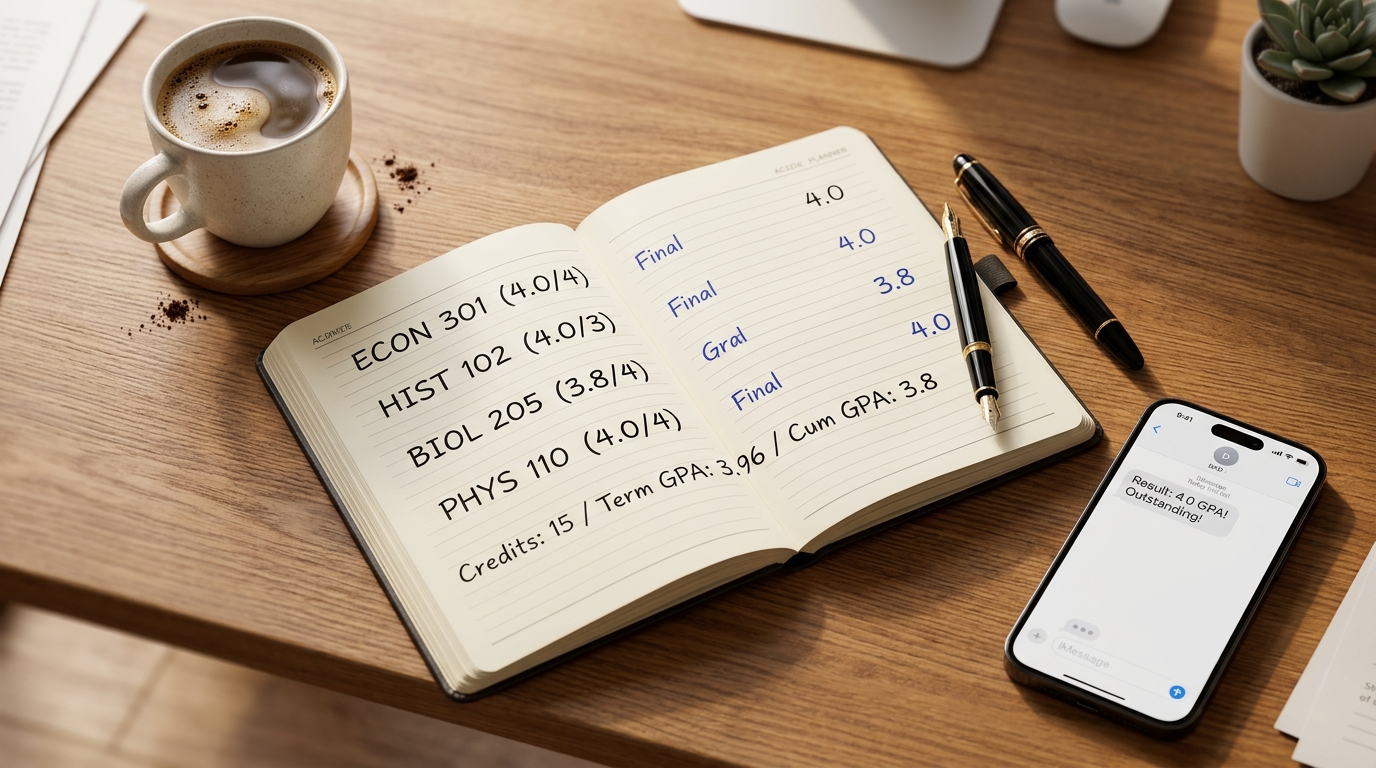
How to Use Our Calculator (Step-by-Step)
We designed this tool to be incredibly simple, so you don't need to be a tech expert to use it. Here is exactly how to get your results:
- Add Your Courses: Look at the tool above. Click the "Add Course" button. A new row will appear.
- Enter Course Details (Optional): You can type the name of the course (like "Calculus" or "Physics") just to keep track. This doesn't affect the math.
- Select Your Grade: Use the dropdown menu to select the grade you expect (or have received) for that course.
- Enter Credit Hours: This is crucial. Enter the credit hours for that specific course. Usually, major subjects are 3 or 4 credits, while labs are 1 or 2 credits.
- Calculate Semester GPA: Once you have added all your courses for the current semester, click the green "Calculate Semester GPA" button. Your result will pop up below.
- Calculate Overall CGPA: If you want to know your cumulative CGPA, look at the second section. Enter your previous CGPA (before this semester) and the total credit hours you have already completed in your degree. Click "Calculate Final CGPA" to see your new cumulative score.
Why Your CGPA Matters More Than You Think
Some people will tell you that "CGPA doesn't matter in the real world." While it is true that skills are important, dismissing your CGPA entirely is a huge mistake, especially in Pakistan. Here is why it matters:
- Scholarships: If you want to study abroad on a fully funded scholarship (like Fulbright, Chevening, or Erasmus), a high CGPA (usually 3.5+ out of 4.0) is almost always a mandatory requirement. Local HEC scholarships also have strict cut-offs.
- Higher Education: If you plan to do a Master's or MPhil in a reputable university, you need to meet their minimum CGPA criteria. Some programs won't even look at your application if you have a CGPA below 2.5 or 3.0.
- Job Market: Big corporations, banks, and multinationals often receive thousands of applications for a single entry-level job. To filter them, HR departments use CGPA as a quick benchmark. A 3.5+ CGPA gets your resume noticed, while a 2.5 CGPA might get auto-rejected.
- Government Jobs: While some government jobs only require a passing degree, highly competitive posts (like in the civil service or specialized technical departments) might have minimum CGPA requirements.
What to Do If Your CGPA is Low?
First, take a deep breath. It is not the end of the world. Plenty of people with average CGPAs go on to have incredibly successful careers. But you do need a strategy to compensate for it.
Focus heavily on building practical skills. If you are in IT or engineering, build a strong portfolio of projects. If you are in business, try to get internships or start a small side hustle. Certifications from Google, Microsoft, or other recognized platforms carry a lot of weight. When you apply for jobs, highlight your skills and experience prominently. A strong interview and a great portfolio can often override a mediocre CGPA, but you have to get past the initial HR filter first. Networking is key. Connect with professionals on LinkedIn and try to get referrals.
Tips to Improve Your CGPA in the Coming Semesters
If you still have a few semesters left, you have time to turn things around. Here is how:
- Know Your Syllabus: Don't wait for the teacher to explain everything. Read the course outline on day one. Understand how much weight is given to assignments, quizzes, midterms, and finals.
- Never Miss the Easy Points: Assignments and quizzes are free marks. Even if you are not the smartest student in the class, just submitting every assignment on time and attending all classes can boost your grade significantly.
- Choose Electives Wisely: If you have the option to choose elective courses, don't just pick the hardest ones to look smart. Pick courses that genuinely interest you or ones that have a reputation for fair grading. Protect your CGPA.
- Seek Help Early: If you are struggling with a subject, talk to your professor immediately. Don't wait until the final exam. Most teachers respect students who show the initiative to improve.
Reviewed by Habib Ur Rehman
Founder & SEO Specialist at LiveGovJob
"I built this tool after seeing my peers struggle with manual calculations every semester. My goal is to provide accurate, free tools that make academic life a little less stressful."
Frequently Asked Questions
What is a good CGPA in Pakistan?
Anything above 3.0 out of 4.0 is generally considered good. A CGPA of 3.5 or above is excellent and opens doors to top scholarships and multinational jobs. If your CGPA is below 2.5, you might face difficulties with university admissions for Master's programs and some private sector job applications.
Does this tool save my data or grades?
Absolutely not. Your privacy is a top priority for us. This tool runs 100% in your browser using JavaScript. We do not send your grades, credit hours, or any personal data to our servers. Once you close the page, the data is completely gone.
What happens if I fail a course (get an F)?
If you receive an F, you get 0.0 grade points for that course. This will severely drop your semester GPA and negatively impact your overall CGPA. You will be required to retake the course in a future semester (usually called a 'repeater' or 'summer' course) to clear it. When you retake it, your new grade will replace the F in your CGPA calculation, but the F will still show on your transcript.